
Wheel Spacers as Free Grip: The Track Width Math
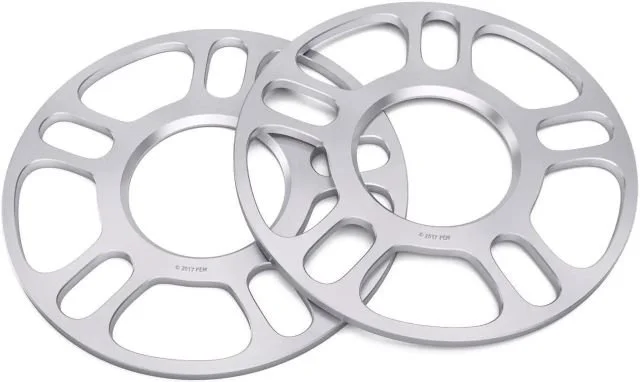
Wheel spacers are one of the most underrated tools in any class that allows them, because most people see them as a fitment fix or a "stance" item rather than what they actually are: a free, bolt-on increase in lateral load transfer resistance. In the ST ruleset, wheel offset is generally unrestricted within fender coverage rules, which means spacers (or equivalently, more aggressively negative-offset wheels) are a legal lever on one of the most fundamental handling parameters of the car.
The core physics
Lateral load transfer across an axle during cornering follows this relationship:
ΔW = (m · a · h) / t
Where:
ΔW = weight transferred from inside to outside tire
m = mass supported by that axle
a = lateral acceleration
h = CG height of the sprung mass acting through that axle
t = track width
Track width sits in the denominator. Widen the track and you directly reduce the magnitude of lateral load transfer at a given cornering force. Less load transfer means the outside tire isn't pushed as deep into the nonlinear region of its grip curve, and the inside tire stays more loaded and continues contributing meaningfully.
Why this is "free" grip
Tires don't return grip linearly with vertical load. A tire at 1,200 lb of vertical load does not produce twice the lateral force of one at 600 lb — it produces something like 1.7-1.8x, depending on the construction and compound. This is tire load sensitivity, and it's the entire reason load transfer hurts you.
Total axle grip is the sum of inside and outside tire grip. The more evenly you can split vertical load between the two, the more total grip the axle generates. Widening track width doesn't change total downforce on the axle, doesn't change CG height, doesn't change the cornering force you're trying to make — it just splits the existing load more evenly between the two tires on that axle. That's why people call it free: you're only adding mass in the most trivial of quantities, not adding drag, not adding mechanical complexity. You're just moving the contact patches further apart.
The numbers in practice
Take a typical ST car: 2,800 lb, roughly 55/45 weight distribution, CG height around 19 inches, pulling 1.2 g in a steady-state corner. Front axle carries ~1,540 lb of sprung mass.
Stock front track of 60 inches: ΔW = (1,540 × 1.2 × 19) / 60 = 585 lb transferred
Add 15mm spacers per side (total track width increase of 30mm, or about 1.18"): ΔW = (1,540 × 1.2 × 19) / 61.18 = 574 lb transferred
That's an 11-lb reduction in load transfer at the front axle. Sounds small, but consider: the outside tire is now operating about 11 lb lower on its load curve and the inside tire 11 lb higher. On a tire generating ~1.4 g of peak lateral, that translates to roughly a 1-2% improvement in total axle grip — and 1-2% across a 60-second autocross run is meaningful time.
Stack 25mm spacers per side and the math gets more interesting: you're now looking at a ~3% effective grip improvement at that axle for the cost of four pieces of billet aluminum.
The tuning dimension nobody talks about
Here's where it gets clever: track width is one of the cleanest front-to-rear balance adjustments available, because load transfer scales inversely with track width on each axle independently.
Want more front grip relative to rear? Widen the front track more than the rear. Want to loosen up a push-prone car? Run a bigger spacer up front than out back. This is the same effect you'd get from softer front bars or stiffer rear bars, but it doesn't change ride frequency, doesn't change roll stiffness distribution in a way that affects compliance, and doesn't change how the car handles bumps mid-corner.
The caveat
For autocross, this is really only very beneficial up front. In the rear, you’re widening the dimensional restriction of the car through a slalom. So I’d be looking elsewhere to tune setup.
There’s also a degree of extreme where you can run into issues where the effective scrub radius is more detrimental than the track width is beneficial. While uncommon, it’s still something to look out for.