
No, your NC, ND, or RX8 does not have a Torsen. (And a bit of Mazda diff history)
Spend any amount of time paying attention to internet chatter surrounding Miatas and you'll see people confidently suggest that Miatas have Torsen diffs, and then feel far more confident in their decision to retain the OE diff in the car as a result. Torsen is a specific brand of gear driven, torque sensing differential, and Mazda only fitted it to a narrow slice of the MX-5's production run. The current car doesn't have one. The NC never had one. Most of the late NBs don't have one. Neither does the RX-8, no matter what some old "forum expert" on miata.net or a fake name on a Facebook group says.
We probably end up having this conversation once a week with someone setting up an NC, ND, or RX8 for a particular racing class, who is certain their car has a Torsen (or, the most recent amusing one, a "Torsion"). The name got repeated in enough places that it stopped being questioned, and now people are making setup decisions around it. So here's what Mazda actually put in the housing, in which cars, behind which ratios.
What Mazda Actually Used
Open. No limiting action at all. Torque bias ratio of 1:1, meaning it will happily send everything to the unloaded inside rear tire. This was standard fitment on base Miatas across every generation, and it's what nearly every automatic got. And amusingly, this is also how most older, worn, and likely broken Tochigi-Fujis function now. More on this later.
Viscous LSD (VLSD). A sealed silicone fluid coupling. Speed difference between the axles shears a thin film of fluid, the fluid thickens, and torque transfers. It's speed sensing, not torque sensing, and the Miata unit generally doesn't get hot enough in normal street driving to do a whole lot.
That last point is a street driving observation though, and it gets repeated as if it settled the matter. It doesn't. In rules limited competition the viscous is worth taking seriously, because sometimes it's the only thing you're allowed to run. SCCA's EST (the class formerly known as STS) permits no limited slip differential at all except a factory viscous coupler unit. For a 1.6 NA autocrosser in that class, the VLSD isn't a compromise you settle for, it's the entire menu. Particular setup styles and a few well chosen tweaks can get a viscous working quite well in that context, and people have been quietly doing exactly that for years.
Torsen (TORque SENsing). A gear driven, torque biasing design with no clutches and no fluid coupling. Two versions showed up in Miatas:
Type I (T-1). Crossed axis helical gears, higher potential torque bias (roughly 2.5 in Miata trim), fussier setup.
Type II (T-2). Parallel axis helical gear sets. Simpler, cheaper to build, generally considered the stronger unit in this application.
The practical appeal is that a Torsen behaves like an open diff until it's loaded, has no wear items, and needs nothing more than clean gear oil.
The catch is that you get what you get. A Torsen has essentially no user tunability. The bias is baked into the gear geometry, so there's no preload to set, no ramp angles to pick, and no way to make it behave differently on entry than it does on exit. It's a massive upgrade over a Tochigi Fuji, particularly a worn one, but it is nowhere near what you'll get out of a proper clutch type diff like an OS Giken, where lock behavior is something you actually specify. For a street car, or a class that mandates it, that's fine. For a car you're actively developing, the lack of adjustment is a real limitation.
One thing worth knowing: a Torsen for the NC does exist, even though no NC was ever built with one. In 2022, Mazda Motorsports released a Torsen Type-2 designed specifically for the NC MX-5, including the Spec MX-5 car. With a 2.7:1 torque bias ratio on throttle and 2.2:1 on coast, it was deliberately built with no breakaway preload for cleaner turn in. Part number 0000-02-5564, announced at $1,260, sold exclusively through Mazda Motorsports. The full spec is in their announcement post. So if you own an NC and you want a Torsen, the answer isn't "find a good used one." It's a part you buy new, over the counter, from one supplier.
A note on Quaife. The Quaife ATB is not a Torsen. It's a competing helical torque biasing design that works on the same principle, and for most Miata owners it's the better unit. It shares the Torsen's virtues (no clutches, ramps or springs to wear out, standard gear oil, quiet operation, progressive behavior because it never fully locks) and where it pulls ahead is durability. The ATB style units are stronger than either factory Torsen and will realistically outlast the rest of the drivetrain, and Quaife backs them with a lifetime warranty. That matters if you're feeding a Miata diff considerably more torque than Mazda ever intended.
The more important point: a Quaife is available for platforms that never got a factory Torsen at all. If you have an ND or an RX-8, "find a used Torsen" isn't an option, because one was never made for your car. NC owners do have a Torsen available, but only as the purpose built race part above, bought new. An ATB is the closest thing to that upgrade path. On a 1.8 NA or NB it drops straight into an open diff carrier.
Tochigi Fuji "Super LSD." Worth noting that "Super" is part of the brand name, not an adjective Mazda's marketing department got carried away with. It's a cone clutch design. As torque passes from the ring gear through the pinions, the conical side gears get forced outward into friction surfaces inside the case. Cone clutches transmit more torque per unit of diameter than flat plates, which is why Mazda could package one in a small housing. It's torque sensitive in behavior, which is exactly why people mislabel it a Torsen, but mechanically it's a clutch type diff and it has wear items. Tochigi Fuji Sangyo later became part of GKN Driveline Japan.
Asymmetric LSD (2024+). Mazda's first genuinely new differential mechanism in about two decades. Still a conical clutch unit, but with an added cam mechanism giving different ramp angles on acceleration versus deceleration. More lockup under engine braking to stabilize corner entry, less lockup on power to reduce understeer. Whatever else you think of it, that's a real attempt at using the diff as a balance tool rather than just a traction device.
Generation by Generation
NA1, 1990 to 1993 (1.6L)
Small 6 inch ring gear. 4.30:1, universally. Open standard, viscous LSD optional. No Torsen was ever offered in a 1.6 car, and the 6 inch housing is a dead end for ratio swaps because nobody makes aftermarket ring and pinion sets for it. If you want options, you're swapping to a 1.8 rear end along with the driveshaft and axles.
NA2, 1994 to 1997 (1.8L)
The 7 inch ring gear arrives, and with it the Torsen. 4.10:1 for both manual and automatic in most markets. Open standard, Torsen optional and usually bundled with R-package and M-Edition cars. Type I in 1994 and early 1995, Type II from late 1995 onward. A handful of JDM specials, the RS Limited among them, got 4.30 Torsen units.
NB, 1999 to 2005 (1.8L)
Same 7 inch ring gear, considerably more ratio variety, and a mid generation change of diff supplier that trips people up constantly.
Ratios by market and gearbox:
NB1 5-speed (US, Japan): 4.30:1
NB1 5-speed (Australia, Europe): 4.10:1
10th Anniversary Edition, 6-speed: 3.909:1
NB2 6-speed (US, Japan): 3.909:1
NB2 6-speed (Australia, Europe): 3.636:1
2004 to 2005 6-speed including Mazdaspeed (US): 4.10:1
Automatics, 2000 to 2005: 4.10:1
The diff itself is Torsen Type II from 1999 through 2002. From roughly 2003 to the end of production, naturally aspirated LSD cars got the Tochigi Fuji Super LSD instead. 2003 is the messy year. There are credible reports of both units, so don't assume based on model year alone.
The exception is the 2004 to 2005 Mazdaspeed Miata, which is widely reported to have kept a Torsen, paired with larger diameter axles and hubs. If you're swapping an MSM rear end into a standard NB, you need those shafts too.
NC, 2006 to 2015
No NC ever left the factory with a Torsen. If an NC has an LSD, it's the Tochigi Fuji cone clutch Super LSD. And most NCs don't have one at all. In the US it came bundled with the Suspension Package, manual transmission only. Every automatic got an open diff.
US market NCs used 4.10:1 essentially throughout. Overseas gets messier: UK cars ran 4.10 on 5-speeds, 3.727:1 on 2.0 6-speed Sports, and 3.909 on some later 1.8s. JDM Roadsters were mostly 4.10.
If you want a Torsen in an NC, it's the Mazda Motorsports part covered above. There is no used one to go find.
ND, 2016 to present
Also not a Torsen, in any year, in any market.
For 2016 to 2023 cars, Mazda never published the internal mechanism in any detail, but it belongs to the Super LSD family. Clutch type, and demonstrably not a Gleason / JTEKT product. We'd treat "clutch type" as the cautious description rather than a confirmed spec, because nobody has produced a primary source pinning it down.
From the 2024 ND3 refresh, LSD equipped manuals get the new Asymmetric LSD described above. In the US that means Club and Grand Touring manuals, and the Sport trim doesn't get it. Availability has moved around over the ND's life: Club only early on, added to GT with the 2019 GT-S package, then standard on manual GTs from 2020.
Ratios:
1.5 and 2.0 manual, all markets: 2.866:1
Automatic (US): 3.454:1
Automatic (UK, Europe): 3.583:1
Automatic (JDM): 4.10:1
That 2.866 looks absurdly tall next to a 4.30 NA until you notice the ND's 6-speed runs a 1:1 top gear and a very short first. The gearbox is doing work the ring and pinion used to do, so don't compare final drive numbers across generations and draw conclusions.
And the RX-8
The RX-8 gets grouped in here because its rear end is a common donor and because it's mislabeled even more aggressively than the Miata's. Manual RX-8s came with the Tochigi Fuji Super LSD. Same cone clutch family as the NB2 and NC, NOT a Torsen. You'll find forum posts, parts listings, and at least one book on the car describing it as a preloaded Torsen with reduced torque bias. It isn't one.
2004 to 2008 manual: 4.444:1
2009 to 2011 manual: 4.777:1
Automatic, all years: 4.30:1
Those are very short ratios chosen to suit a high revving rotary with almost no low end torque. Worth remembering before you drop one into a Miata expecting a bargain.
So What Actually Has a Torsen?
The complete list:
1994 to 1997 NA 1.8 with the optional LSD (Type I early, Type II from late '95)
1999 to 2002 NB with the optional LSD (Type II)
2004 to 2005 Mazdaspeed Miata (Type II, larger axles)
A scattering of JDM special editions
That's it. NOT the 1.6 NAs. NOT the 2003 to 2005 naturally aspirated NBs. NOT any NC as delivered, since the only NC Torsen is the Mazda Motorsports part you buy separately. NOT any ND, including the one currently on dealer lots. NOT the RX-8.
And if a listing says "Super Torsen LSD," that phrase does not exist as a product. It's a seller splicing Mazda's "Super LSD" brand onto Torsen's, and it's a reliable signal that whoever wrote it has no idea which unit they're selling.
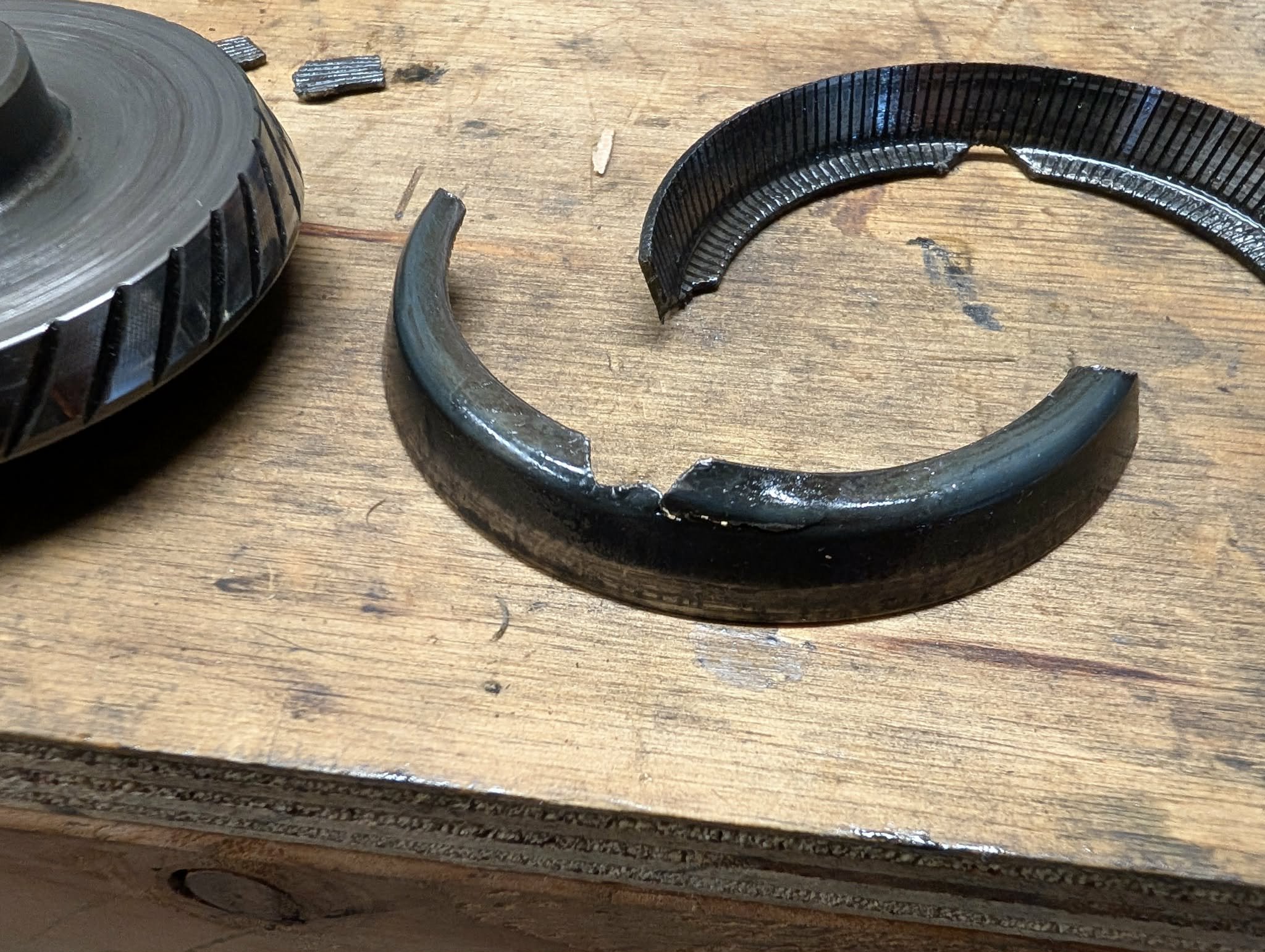
The inevitable fate of all of teh Tochigi Fuji units.
Maintenance, and the Tochigi Fuji Problem
A Torsen has no serviceable wear items. Fluid changes and nothing else. The cone clutch units are a different story, and here we'll be blunt: the Tochigi Fuji Super LSD is not a reliable differential.
The failure point is the small friction cones sitting behind the spider gears. The tabs locating them crack and shear off, sometimes at genuinely low mileage, and once that happens the unit stops limiting anything. The vast majority of these we've opened up have been totally failed. Not worn, not marginal, but finished, with broken pieces of clutch material rattling around loose inside the diff case.
The insidious part is that nothing about the failure announces itself. No noise, no warning light, no dash message. The car just spins the inside rear tire on corner exit, which most owners write off as "that's just a Miata thing." Plenty of people are driving what is functionally an open diff and don't know it. And it's worth thinking about what all that loose debris is doing in the meantime, because it contaminates the fluid and gets dragged through the bearings and the ring and pinion.
If you've got a 2003 or later NB, any NC, or an RX-8 with the factory LSD, and nobody has ever had it apart, assume nothing about its condition. Several suppliers now sell clutch plate conversion kits that replace the cone system outright, which tells you how common the failure is. Enough of these have died that fixing them properly became its own product category.
On fluid, follow the manual for your specific unit rather than a generalization about "LSDs." Friction surface diffs care what's in the oil in a way a Torsen doesn't.
On Track Behavior and What We'd Actually Run
The real limitation of a Torsen isn't how much it locks, it's that the amount isn't a variable you control. Bias is a multiplier on the torque passing through the diff, so when there's very little torque going through it (trailing throttle, mid corner, that part throttle window where you're trying to balance the car near the apex) there's very little to multiply and the thing is barely doing anything. There's no meaningful preload to change that either. Some Torsens ship with a little, the Mazda Motorsports NC unit was deliberately built with none, but either way it isn't a knob you get to turn. Entry, apex, and exit behavior are all tied to each other by the gear geometry, and you take what the geometry gives you.
A clutch type hands all of that back to you as setup. Ramp angles separate the accel side from the decel side, so you can ask for lock under engine braking to settle the car on entry without also dragging it into push on exit, or the reverse. Preload sets how much lock exists before real torque is going through the diff, which is exactly the low torque region a Torsen effectively ignores. Plate count and clamp load set the ceiling. And when the car changes, more power, more grip, a different tire, you can retune the diff rather than accept that it is what it is. That's the difference between a part and a setup variable, and on a car you're actively developing it matters.
So for a serious track or autocross car, that's the argument for a plate type diff, and it's worth the maintenance it demands. Cusco, Kaaz, and OS Giken all offer plate type units depending on the platform, and IMO the OS Giken Superlock is the one to have. It's rebuildable, ships in a 1.5-way configuration that suits the overwhelming majority of users, can be reconfigured as a full 1-way or 2-way, and OS Giken's tolerances are tight enough that it skips the figure eight break in procedure other plate diffs demand. It's the most expensive option here by a comfortable margin, and that's the trade.
You don't have to take the off the shelf setup either. Our friends over at Shaftworks are happy to build one to your specifications, or to set it up to one of the tunes they've developed through years of experience doing this. They'll also inspect, retune, and rebuild a used unit you already have, which is worth remembering before you write off a tired diff and buy new.
TLDR: 1994 to 2002 1.8 cars with the LSD option (plus the MSM) have a Torsen. Everything after that, including every NC, every ND, and every RX-8, has a cone clutch Super LSD or an open diff, and a large share of those Super LSDs are already broken. Know what you actually have, and stop assuming you have something that was never built in the first place. If you're competing in the car and you're serious about it, talk to our friends at Shaftworks about an OS Giken.